

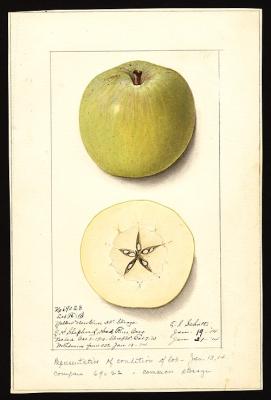
Albemarle Pippin Apple | Malus pumila 'Albemarle Pippin'
Albemarle CiderWorks is most particularly about apples. The company’s roots are in the founders’ dedication to preserving and promoting distinctive apple cultivars and often ones that have not lent themselves to the demands of mass production and distribution that typifies our modern food systems. One of our most prized varieties is the Albemarle Pippin, a legendary apple in this part of the world. It was Albemarle CiderWork's first single-varietal cider, and it remains a cornerstone among the traditional, dry style ciders we produce.
The Pippin has been called "the best apple that ever grew". This is a sweeping statement, but when grown well, probably true. It’s vinous , sweet and tart flavor makes it a wonderful dessert, culinary and cider apple. More tart when first off the tree at the end of apple growing season, like all apples, it mellows in storage and its sugars improve as the apple ages; however, it has the distinction of remaining firm and becoming more complex in flavor as the months progress. All of this is only true when the apple is well grown, and therein lies the challenge: the Albemarle Pippin is hard to grow. Apples are notoriously terroir conscious and the Pippin certainly is.
The apple traces its origins to about 1700 in what is now Long island, New York (the apple is called there and elsewhere by its other name, the "Newtown Pippin"). The Newtown Pippin was singular at the time not only for remarkable flavor, but its keeping qualities & late ripening. Keeping power was a very valuable attribute in the 1800s, when the world lacked refrigeration and decent transportation.
Brought into Albemarle county in 1755 by Colonel Thomas Walker of Castle Hill, who returned from the French and Indian War with scion wood in his saddlebags. Walker’s step-daughter lived on a farm at North Garden, Virginia and planted Pippin trees there. Benjamin Franklin had imported Pippins to London when he was a Colonel Minister for the English Court.and they brought prices several times higher than most apples on the London market. The English growing season was too short for the Pippin to ripen there but throughout the 19th century the apple flourished in counties along the eastern Blue Ridge,including Albemarle and were packed in barrels for shipment to Europe. As the 19th century wore on and sectionalism raised its ugly head, Virginia growers discovered they could increase their profits by exporting their Pippins, ("Albemarle Pippin"), directly from Chesapeake Bay; cutting out the New York middlemen who had dominated the trade.
In Christmas of 1838, Andrew Stevenson, the American Ambassador to Great Britain and his wife Sally Coles of Enniscorthy 9in southern Albemarle)received a barrel of apples from her home. She packed a silver basket of the apples to be presented to the court. She wrote back to her family that they caused "a sensation". "They were enjoyed and admired by royal and noble palates. Lord Melbourne ate 2 huge ones. It was feared that he would suffer adverse consequences." He didn't. The apple was so popular with the young Queen Victoria that Parliament rescinded the import duty on the Albemarle Pippin. That advantage ended after World War I, when Britain's tariff policy shifted to favoring its commonwealth countries (New Zealand and Australia et.al). However, its legacy lives on among locavores, like the Charlottesville chefs & bakeries, who seek it out from our orchard each fall for their restaurants.
This is an excellent dessert, culinary and cider apple, harvested in the deep Autumn months of late October, early November. It lives on, beautifully showcased, in our Royal Pippin Ciders.
Picture: USDA pomological watercolour: Yellow Newton Apple



Add comment