
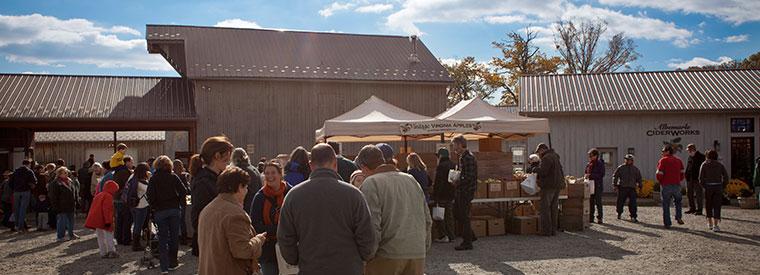
Virginia cider has been uniting Americans since before the nation's founding
Joana Suleiman | June 13, 2026 | The Daily Progress, article here
In America's earliest days, cider was the go-to drink for the very richest and very poorest. 250 years on, America still loves cider and Virginia produces some of its very best.
Benjamin Franklin celebrated the longevity and deliciousness of cider in his 1733 edition of "Poor Richard's Almanack," writing "Give me yesterdays bread, this day’s flesh, and last year’s cider."
George Washington rallied voters to his side in the 1758 Virginia House of Burgesses election using 144 gallons of the stuff.
Thomas Jefferson was an early pioneer in cider production, using the 18 varieties of apple he planted at his Monticello estate between 1769 and 1814.
John Adams, who lived to be 90 years old when the average American life expectancy was 40, credited his long life to the tankard of cider he drank every morning.
But cider was not just the drink of choice for Founding Fathers; it was the drink of choice of the common man in early America. And its enduring popularity today, 250 years after the nation's founding, speaks to its universal appeal.
"Apples in early America were originally grown primarily for cider, which was vital in an era when you needed food with vitamins and nourishment in the winter months,” Alistair Reece told The Daily Progress. “Cider was the health drink that helped keep you alive. Soldiers in the Revolutionary War were allotted a daily ration of 1 quart of cider. Along with vinegar and lemon juice, it stopped you from getting scurvy because it's got just enough vitamin C to prevent the disease. Fermentation for cider also killed things like E. coli."
Reece, born in the Scottish Highlands but now residing in rural Central Virginia, runs Fuggled, a long-running beer and brewing blog. He also is the author of "Virginia Cider: A Scrumptious History," which was published in 2024.
“One of the things that really struck me when I was doing my research is how cider crossed every social class,” he said. “Quite often, we focus on the fact that Jefferson and Washington drank a lot of cider, but it wasn't just restricted to that kind of upper planter class. It was a common drink. Every homestead had its own orchard, and even enslaved communities were given cider during holidays and festivals.”
Cider is such a central part of Virginia's history and culture that Reece found orchards, presses and individual bottles of cider being passed down in wills dating back to pre-colonial times.
Like many Scots, Reece grew up on cider.
“It was just normal to give kids a glass of cider with dinner on a Sunday. Cider was always a part of my life,” he said.
Little did he know that when he moved to Central Virginia in 2009, he would encounter the oldest operating cidery in the commonwealth.
“My wife's from South Carolina. As we were driving up [U.S.] 29 to move here, we noticed a sign on the road for Albemarle Ciderworks. I filed it in my brain that we were going to go and visit. A couple of weeks later after we got settled in, we went back. They had only been opened for two weeks at that time and were serving three ciders: Jupiter’s Legacy, Ragged Mountain and Royal Pippin. We did the tasting with owner Charlotte [Shelton] and I just stood there, amazed at the fine quality of what we were drinking. They’re the real deal,” Reece recounted.
Seventeen years later, Reece not only continues to visit the North Garden cidery — and write about it on his blog — but he has an orchard of his own consisting of 13 apple trees in his backyard, all of them from Albemarle Ciderworks.
“The influence they’ve had on renaissance cider is impossible to overstate,” Reece said of the Albemarle operation.
Of the 24 members of the Virginia Cider Association, at least 18 have been established in the years since Albemarle Ciderworks first opened its doors.
Siblings Charlotte and Chuck Shelton, who own Albermarle CiderWorks and the surrounding orchard, now offer 18 different cider varieties.
“We're a farming family, but we moved to Charlottesville in 1961 because of my father's job, which was with Virginia's Department of Forestry. We sold the family farm in Amherst County and bought this in 1986 and then began planting apples more or less as a hobby in the early '90s. And as I tell people, it rather got out of hand,” Charlotte Shelton told The Daily Progress with a chuckle.
Albemarle Ciderworks not only produces the cider that Reece loves, but the ones the Founding Fathers' loved too.
“The crab is one that I would say is Virginia's quintessential in nature. It was Washington's favorite cider. He had ciders sent to him in New Jersey during the revolution. Probably Virginia's best cider apple is a little Virginia Hewes crab; Jefferson grew it at Monticello," Charlotte Shelton said.
In addition to those historical flavors, Albemarle Ciderworks also uses historical equipment, such as a roughly 175 year old press — but only for demonstration purposes.
"This machine was mid-1800s," Chuck Shelton said of the press. "There were models before that, but this one came from somewhere in Ohio."
While the Sheltons use mechanized presses and steel tanks, they remain advocates for heirloom apples and make them the stars of their production. It's a celebration of Virginia's, and America's, long history of cidermaking — one that is not about to stop 250 years into the great American experiment.
“Historically in Virginia, there was a lot of pride taken in the quality of your cider. The Sheltons are certainly keeping that tradition alive with their craft,” Reece said.