
Ben Swenson | Nov 16, 2025 (updated Mar 30, 2026) | The Daily Progress, article here
Odds are good there’s a familiar name or two in your pantry as we speak: Gala, Fuji, Granny Smith, Red Delicious. Apples, and the numerous foods we make with them,
always rank among the most consumed fruits, nearly universally enjoyed because they’re inexpensive, nutritious, and versatile. Americans’ affinity for apples predates the founding of the United States, but if you could travel back in time a century or more, you’d have to search the far corners of the globe to find the kinds of apples now sold in supermarkets — if you could find them at all. The apples our ancestors consumed came in thousands of varieties. Many of those types are now extinct. Thanks to fervent preservationists and consumers willing to expand their palate, however, some rare apple varieties thrive, and Virginians are foremost among those helping to carry the torch.
The commonwealth is an intuitive nursery for old apples. Thomas Jefferson was an early apple booster, cultivating varieties such as the Taliaferro, Hewe’s Crab, and Newtown (or Albemarle) Pippin. The Taliaferro, Jefferson wrote, was “the best cyder apple existing.” And writing from Paris about European varieties, he boasted that “they have no apples here to compare with our Newtown Pippin.” If there is a modern-day Founding Father of heritage apples in the commonwealth, that title belonged to Tom Burford, who died in 2020. A native of Amherst County, Burford became a prolific pomologist (scientist specializing in the study and cultivation of fruits and nuts) and nurseryman who rediscovered and revived scores of rare apple varieties. This labor of love took decades for Burford to successfully accomplish, given the lengthy time horizons involved.
Apples don’t grow true to seed. Plant the seeds at the core of an apple, and you’ll get a tree, but the fruit won’t be the same as that of the parent. Countless varieties have taken root over the long history of the apple, but from a human perspective, the vast majority have been duds, not fit for pressing for juice, eating raw, or cooking. Yet every now and then, a winner emerges. To keep those genetics alive, the only solution is grafting — taking cuttings from a desirable tree and surgically attaching them to robust rootstock. Early Americans knew this, and varieties spread whenever they found good ones. In the latter half of the 20th century, farmers and the food industry selected apples that had traits desired by modern consumers — appearance, mild flavor, and ability to handle long-distance transport, for instance. That genetic selection happened with all sorts of agricultural commodities, from corn to chicken. Because they weren’t pretty or tasted a little too acidic, thousands of types of heirloom apples that once dotted the American countryside began to wink out of existence. Jefferson’s Taliaferro was likely among the casualties. There’s no bringing it back, not even with cutting-edge technology.
Across Virginia, heirloom apples mostly survive as one-offs or in relatively small orchards, like that found at Matthews State Forest in Grayson County. Administered by the Virginia Department of Forestry, the 566-acre plot was donated to the commonwealth by Judge Jack Matthews and his wife, Clare. During his life, Matthews cultivated what he called “old-timey apples,” more than 40 heirloom varieties with names such as Sweetstone Rimson, Mutse Old Milles, and Mother.
“Try to find 40 varieties of apples, and you won’t see that in a farmer’s market, much less in a supermarket,” says Zach Olinger, forest manager and education specialist for
the Virginia Department of Forestry. Many of Matthews’ trees remain in his onetime orchard, but like heritage trees elsewhere, they’re vulnerable. “In commercial orchards, they have smaller trees that are very intensively managed,” he says. “These are older, standard-sized trees. Just like older humans or animals, they’re more susceptible to diseases and natural disasters. They don’t have the health and vigor they once did.” The state forest has been working with Virginia Cooperative Extension to try to create new scions of some of Matthews’ trees as they near the end of their life.
When Burford set about rescuing the genes of rare apple trees, he recognized that there was a non-negotiable timeline involved. He searched hills and hollers for those
unique but aging apple trees and grafted their wood onto vigorous rootstock, breathing new life into them. In the 1980s, Burford assisted Peter Hatch, director of gardens and
grounds at Monticello, in replanting heirloom apple trees that once graced Jefferson’s Charlottesville estate. Burford found and cultivated rare varieties and lectured around Virginia and beyond about the importance of saving them. He also knew that saving rare varieties would rest in a robust cider industry.
He was onto something. Virginia remains a small player in the national apple industry — it’s the sixth largest producer — but almost all the apples grown in commercial orchards
today are familiar varieties, such as Golden Delicious and Granny Smith, according to Jim Atwell, program manager for the Virginia Apple Board. Atwell says that heirloom apples aren’t grown at any sort of scale but that the proliferation of cideries in Virginia has led to a modest renaissance in the cultivation and consumption of rare varieties.
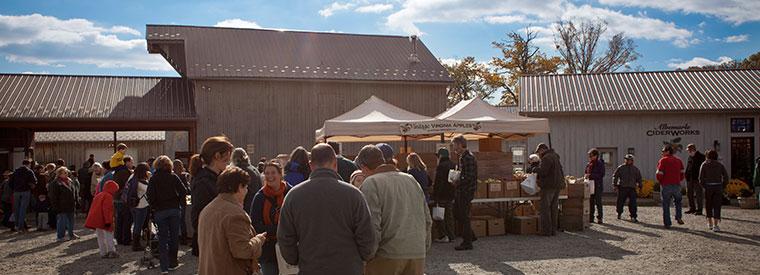
Albemarle CiderWorks and its sister business Vintage Virginia Apples, which sells heirloom apple trees, spreads among pastoral rolling terrain in North Garden, 10 miles southwest of Charlottesville. The late Bud and Mary Shelton, along with their four children, purchased the property in 1986, and among the first items on the to-do list was
planting fruit trees. “We started with 20 trees,” says Charlotte Shelton, the eldest of the Shelton children and CEO of the operations. The businesses are a family affair; brothers Chuck and Bill and niece Anne Shelton manage the myriad tasks involved in running an orchard, cidery, and nursery.
The enterprise has grown tremendously since the Sheltons first planted fruit trees nearly 40 years ago. Charlotte Shelton, a historian by training, attended heritage apple tastings
held by Burford at Monticello in the 1990s. The distinctiveness of the rare apples’ traits and Burford’s passion for propagating them made a deep impression on her. Today the Sheltons cultivate more than 100 varieties, among them Winesap, Black Twig, Roxbury Russet, and Albemarle Pippin. Charlotte is a fount of heritage apple knowledge, rattling off the properties that once made these apples so beloved: Winesap was the quintessentially American apple, found in orchards far and wide until about the 1940s; Pippin’s claim to fame is that, unlike commercial varieties that must be stored in carbon dioxide until ready to be sold, it will keep in cool conditions, she says, “until
Gabriel blows his horn.” The apples grown onsite are pressed for Albemarle CiderWorks’ award-winning craft cider, which is drier, richer, and more complex than those that are commercially mass produced. The secret, Shelton says, is in the flavors, acidity, and other distinctive properties found only in the heirloom varieties.
The Sheltons’ nursery, Vintage Virginia Apples, offers some 200 heritage varieties, sold as “whips” (not seedlings, as Shelton emphasizes, as they’re not grown from seeds).
Although orders for large numbers of whips come in from time-to-time, most are for just a handful, requested by hobbyists drawn to the novelty of growing a bygone apple or
wanting to do their part to prevent irreversible loss. In the end, it’s people — willing to expand their epicurean horizons or let their green thumbs blossom — who will help stem the decline of these folksy, old apples. Shelton knows that heritage apples will never be grown on an industrial scale, but she contends that getting people through the door gives them a fighting chance. The story of heirloom apples is as compelling as the novelty of consuming them. “I can sell these apples and this cider, but I have to get people here,” she says.